Does Adding the Year to Your Title Help You Get Cited by ChatGPT? I Tested It
ChatGPT added 2026 to most of its searches. The pages it cited rarely had the year in their title. Vendor pricing pages did far better.

Tim, Founder of OthFlow
Published Last updated 13 min read
ChatGPT searched for
best customer support software 2026
What it cited
- The 20 Best Customer Service Software for 2026freshworks.comNot cited
- Front Pricing and Plansfront.com/pricingCited
- Best Help Desk Software in 2026: 10 Tools Comparedtopickz.comNot cited
- Help Scout Pricinghelpscout.com/pricingCited
On this page
- Quick summary
- Why I decided to test the year-in-title advice
- How I ran the test
- Does ChatGPT add the year to its searches?
- Did pages with the year in their title get cited more?
- Was it the year, or the kind of page?
- Which pages did ChatGPT prefer citing?
- What this test can’t tell us
- What I’d do with your page titles
- FAQs
- What I’m taking away from this
- About the author
Quick summary
Not according to my test.
ChatGPT added 2025 or 2026 to 64% of the searches I could see. You’d think that would give pages with the year in their title an advantage. But those pages made up 24% of the search results and only 8% of the pages ChatGPT actually cited.
Vendor pricing pages performed much better, with a 75% citation rate.
Now, this was a small test. I ran 45 questions, once each, so I wouldn’t draw any sweeping conclusions from it. But the results were interesting enough that I wanted to share what I found.
Why I decided to test the year-in-title advice
There’s a piece of advice I’ve been seeing quite a bit in SEO circles: add the current year to your page titles if you want ChatGPT to cite your content.
You’ll find it in SEO blog posts and conference slide decks. And there’s some research behind the idea, too. In May, a B2B SaaS citation study found that 78% of the pages ChatGPT cited had the current year in their title or headline.
The reasoning makes sense at first.
ChatGPT often adds the current year to its web searches. So if someone asks about the best customer support software, and ChatGPT searches for “best customer support software 2026,” you’d expect a page with 2026 in its title to have a better chance of showing up.
But there’s something missing from that argument.
We know ChatGPT searches for pages with the current year. And we know some of the pages it cites have the year in their titles. What we don’t know from those two observations is whether adding the year actually improves a page’s chances of getting cited.
To get a better picture, we’d need to look at the pages ChatGPT found but chose not to cite, too.
I was already pulling this kind of network data from ChatGPT in October, so I figured I’d take a closer look.
I wanted to answer two questions: How often does ChatGPT actually add the year to its searches? And when it does, are pages with the year in their titles more likely to get cited?
How I ran the test (and why I’d be careful with the results)
First, a quick caveat. This was a pretty small test, and I’m sharing it mainly because the results surprised me. I wouldn’t treat it as definitive research.
I put together 45 buyer questions across three B2B software categories: customer support software, healthcare credentialing software, and digital signage. That’s 15 questions per category.
I tried to phrase them the way someone actually shopping for software might. For example, one question asked which of Front, Help Scout, and Hiver would work best for a 20-person customer support team.
I ran each question once in ChatGPT Plus, with web search enabled, on October 27, 2026.
After each answer, I went through the network data ChatGPT sent to my browser.
If you’re unfamiliar with this, it’s the data ChatGPT’s web app streams into your browser while generating an answer. It gives you a bit more visibility into what’s happening behind the scenes.
For this test, I was interested in three things:
- What ChatGPT searched for. These are the web searches it runs while putting together an answer, often called query fan-out.
- Which pages those searches returned. I could see the titles and URLs of the pages that came back.
- Which of those pages ChatGPT actually cited. I matched the links in the final answers against the pages returned in the searches.
What the network data shows for one answer
“Front vs Help Scout vs Hiver: which is better for a 20-person customer support team?”
What ChatGPT searched for
search_model_queries
Front pricing plans 2026 official per seat Growth Scale Premier features
Help Scout pricing plans 2026 official Standard Plus Pro unlimited users pricing
Pages that came back
search_result_groups
Front Pricing and Plans | Front
front.com/pricing
Help Scout vs Front (2026): Pricing, AI and Collaboration Compared
getmacha.com/blog/help-scout-vs-front
What the answer cited
Cite markers
front.com/pricing
CitedChatGPT also opened it
getmacha.com/blog/help-scout-vs-front
Not citedAcross all 45 answers, ChatGPT’s searches returned 2,189 pages. Of those, 603 were cited in the final answers, giving us an overall citation rate of 28%.
There’s one other detail worth mentioning.
The network data also contained 5,612 additional links that appeared only in a background source list behind the answers. Just two of those links were cited, so I excluded that entire group from the analysis below.
With that out of the way, here’s what I found.
First, does ChatGPT actually add the year to its searches?
Yes. Quite often, actually.
Across the 45 answers, ChatGPT ran 247 search steps. But I could only see the actual search text for 47 of those steps.
Those 47 steps contained 221 individual searches, and 142 of them included either 2025 or 2026.
That’s 64% of the searches I could see.
Now, there’s an obvious question here: Was ChatGPT adding the year on its own, or was it simply picking up on the wording of my questions?
That’s important because I’d included “in 2026” in 12 of the original 45 questions.
So I went back and looked at the other 33 questions where I hadn’t mentioned a year at all.
The pattern was still there.
Of the 164 searches I could see for those questions, 92 included a year. That’s 56%. And 31 of the 33 answers had at least one search where ChatGPT added a year without being asked.
What ChatGPT actually typed into search
Front pricing 2026 official Starter Professional Enterprise per seat monthly annual
best employee service management ticketing HR IT finance requests 2026 Jira Freshservice ServiceNow
credentialing software pricing per provider monthly 2026 Modio Health OneView CredentialMyDoc
Chrome Sign Builder alternatives Yodeck OptiSigns ScreenCloud ChromeOS 2026
best digital signage software higher education universities colleges 2026 emergency alerts campus review
It was almost always the current year, too. Of the 142 searches that mentioned a year, 141 included 2026, while just three included 2025.
For context, that’s considerably higher than what Ahrefs found in September. In their analysis, 22.9% of ChatGPT’s fan-out searches included 2026.
There are some important differences between our tests, though. Ahrefs used free, logged-out ChatGPT, while I used a paid account and focused specifically on buyer questions.
I can’t tell which of those differences explains the gap, or whether something else contributed.
Still, for the kinds of B2B buying questions I tested, the pattern was pretty clear. ChatGPT frequently added the current year to its searches, even when I hadn’t mentioned one.
So that first part of the year-in-title advice seems to hold up.
But what happens after those searches?
Did pages with the year in their title get cited more often?
This is where things got interesting.
Despite ChatGPT adding the year to so many searches, pages with 2025 or 2026 in their titles were actually cited much less often.
Of the 2,189 pages returned across my test, 530 had either 2025 or 2026 in their titles.
That’s roughly 24% of all the pages ChatGPT found.
But of the 603 pages it cited, only 51 had a year in the title.
That’s just 8% of citations.
Put another way, when a page with the year in its title appeared in the search results, ChatGPT cited it 10% of the time.
For pages without the year, that figure was 33%.
ChatGPT searches for 2026. It rarely cites the pages that say it.
64%
of the searches ChatGPT ran included 2025 or 2026142 of 221 searches we could see
Pages with 2025 or 2026 in the title
Inside “best X” listicles, the year made little difference
ChatGPT shows its search text for some searches only (47 of 247 search steps).
One of the clearest examples came from a question about customer support software.
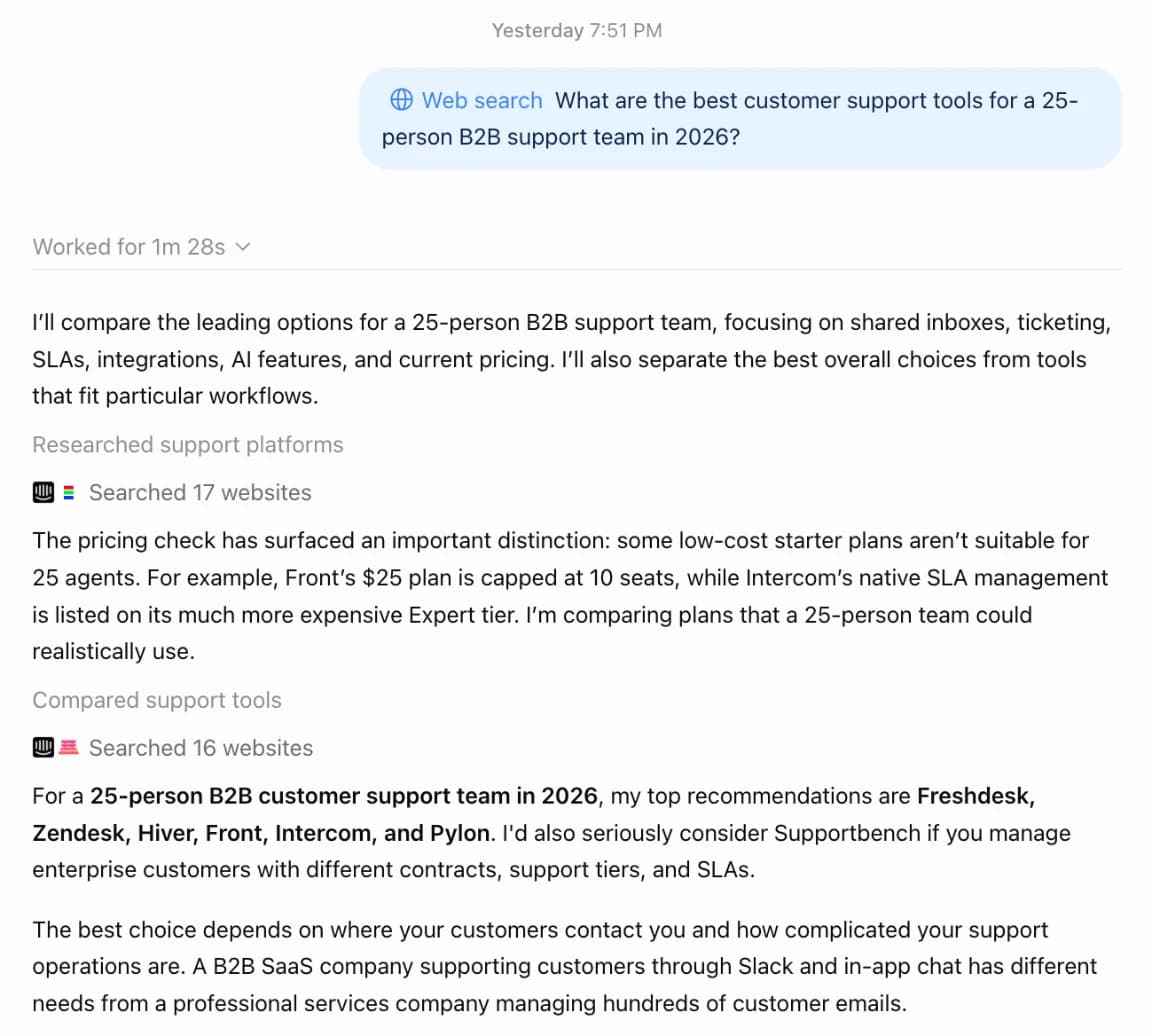
I asked ChatGPT to recommend the best customer support tools for a 25-person B2B team in 2026.
Its searches returned 20 pages with 2025 or 2026 in their titles.
It didn’t cite a single one.
Instead, 10 of the 14 pages it cited were vendor pricing pages.
One ChatGPT answer, two lists
“What are the best customer support tools for a 25-person B2B support team in 2026?”
20 pages with 2025/2026 in the title
came back. ChatGPT cited none of them.
- Intercom Pricing: Plans, Features & Costs (2026)intercom.com
- Best Customer Support Software in 2026: 8 Tools Com…dupple.com
- Best B2B Customer Support Software (2026): 8 Tools…supportbench.com
- Best B2B Help Desk Ticketing Systems (8 Compared, 2…supportbench.com
- Best help desk software of 2026: Freshdesk, Zendesk…itechguides.com
- The 20 Best Customer Service Software for 2026 | Fr…freshworks.com
- 12 Best Customer Service Software of 2026 [Reviewed…freshworks.com
- Best Help Desk Software for Teams 2026 | StackFYIstackfyi.com
- Best Customer Support Tools 2026: Costs & AI | Matc…match-vs.com
- Best Help Desk Software in 2026: 10 Tools Compared…topickz.com
- Customer Support Tools for Mid-Market Teams (2026)…vendorprobe.com
- Best Help Desk Software 2026: Zendesk, Freshdesk, I…codetoolpilot.com
- Plain — 15 Best Customer Support Software for B2B i…plain.com
- Plain — Best Customer Support Tools for Slack and M…plain.com
- Best Shared Inbox Software in 2026: 14 Tools for Su…resources.rework.com
- Best Customer Support Software for B2B SaaS Teams (…userorbit.com
- Front vs Hiver (2026): which help desk software sho…itechguides.com
- 5 Best Shared Inbox Software Tools in 2026hiverhq.com
- Good Zendesk alternatives in 2026?reddit.com
- Zendesk for Customer Service Pricing 2026g2.com
The 14 pages it cited
10 of them are pricing pages.
- www.intercom.com/pricingIntercom Pricing | Plans for every team size
- www.helpscout.com/pricingHelp Scout Pricing: Affordable Customer Support Software
- www.supportbench.com/all-inclusive-pricingSupportbench Pricing: B2B Support Software From $32/Agent
- www.zendesk.com/pricingZendesk Pricing Plans | Starting from $19/month
- www.freshworks.com/freshdesk/pricingFreshdesk Customer Support Software Pricing & Plans | Fre…
- front.com/pricingFront Pricing and Plans | Front
- www.hubspot.com/pricing/serviceService Software Pricing | HubSpot
- hiverhq.com/pricingHiver Omni Pricing | Omnichannel Support, One Platform
- www.usepylon.com/pricingPricing | Pylon
- www.matrixflows.com/buyer-guides/best-slack-custo…Best Slack Customer Support Tools
- www.reddit.com/r/SaaS/comments/1mjudqf/has_anyone…Has anyone replaced Zendesk or Freshdesk with Intercom fo…
- www.reddit.com/r/SaaS/comments/1jackneSupport/ticket software recommendations?
- hiverhq.com/pricing/hiver-in-gmailHiver in Gmail Pricing | Works inside Gmail
- support.zendesk.com/hc/en-us/articles/44088468750…About the Zendesk Suite plan types – Zendesk help
And this wasn’t an isolated example.
Pages with a year in their title showed up in 43 of the 45 answers. But in 19 of those answers, ChatGPT didn’t cite any of them.
At this point, I started wondering whether the year was really the issue, or whether something else about those pages explained the difference.
Was it really the year, or the kind of page?
This was the first thing I wanted to check after seeing those numbers.
A lot of the pages that put the current year in their title are listicles. Think titles like “The 20 Best Customer Service Software for 2026” or “Help Scout vs Front (2026).”
That was certainly true in my data.
Of the 530 pages with a year in the title, 351 had listicle-style titles. That’s roughly two-thirds.
And it turns out listicles generally weren’t doing particularly well in this test.
ChatGPT cited pages with listicle-style titles just 9% of the time, compared with 33% for pages without them.
So page type seems to explain a good chunk of the difference I was seeing.
To check further, I compared listicles with a year in the title against listicles without one.
The gap was much smaller.
Listicles with a year were cited 9% of the time (31 out of 351), while those without a year were cited 11% of the time (8 out of 76).
That’s hardly the kind of difference you’d expect if adding the year gave a page a meaningful advantage.
But I also wouldn’t go as far as saying the year is harmless.
When I excluded listicles and pricing pages, pages with a year in their title still had a lower citation rate: 12%, compared with 30% for those without one.
Now, there were only 154 year-titled pages in that remaining group, so I’d be careful about reading too much into the exact percentages.
Still, across the different slices of data I looked at, I couldn’t find one where having the year in the title improved the citation rate.
That made me curious about which pages ChatGPT was choosing to cite.
So which pages did ChatGPT prefer citing?
Mostly vendors’ own websites.
In fact, vendor pages accounted for 78% of everything ChatGPT cited in my test.
And one page type stood out above everything else: pricing pages.
Vendor pricing pages appeared 165 times in the search results. ChatGPT cited them 124 times.
That’s a 75% citation rate.
None of those pricing pages had a year in their title.
Reddit was a different story.
There’s been plenty of discussion about Reddit’s importance for AI search, but in this particular test, ChatGPT cited Reddit threads only four times out of 48 appearances. That’s an 8% citation rate.
Pricing pages got cited three times out of four
Share of the pages ChatGPT’s searches returned that its answer went on to cite, by page type
But here’s something else I found interesting about pricing pages.
ChatGPT wasn’t only looking for prices when I explicitly asked about them.
Of my 45 questions, 40 made no mention of price or cost. For 39 of those questions, I could see at least some of the searches ChatGPT ran.
And in 22 of those 39, ChatGPT searched for pricing information anyway.
Even more interestingly, 23 of the 40 answers cited at least one vendor pricing page.
You could see this behaviour in the answers themselves.
Remember my question about the best customer support tools for a 25-person B2B team?
I hadn’t asked ChatGPT to compare prices. But it went ahead and created a pricing table showing what each tool would cost for 25 agents.
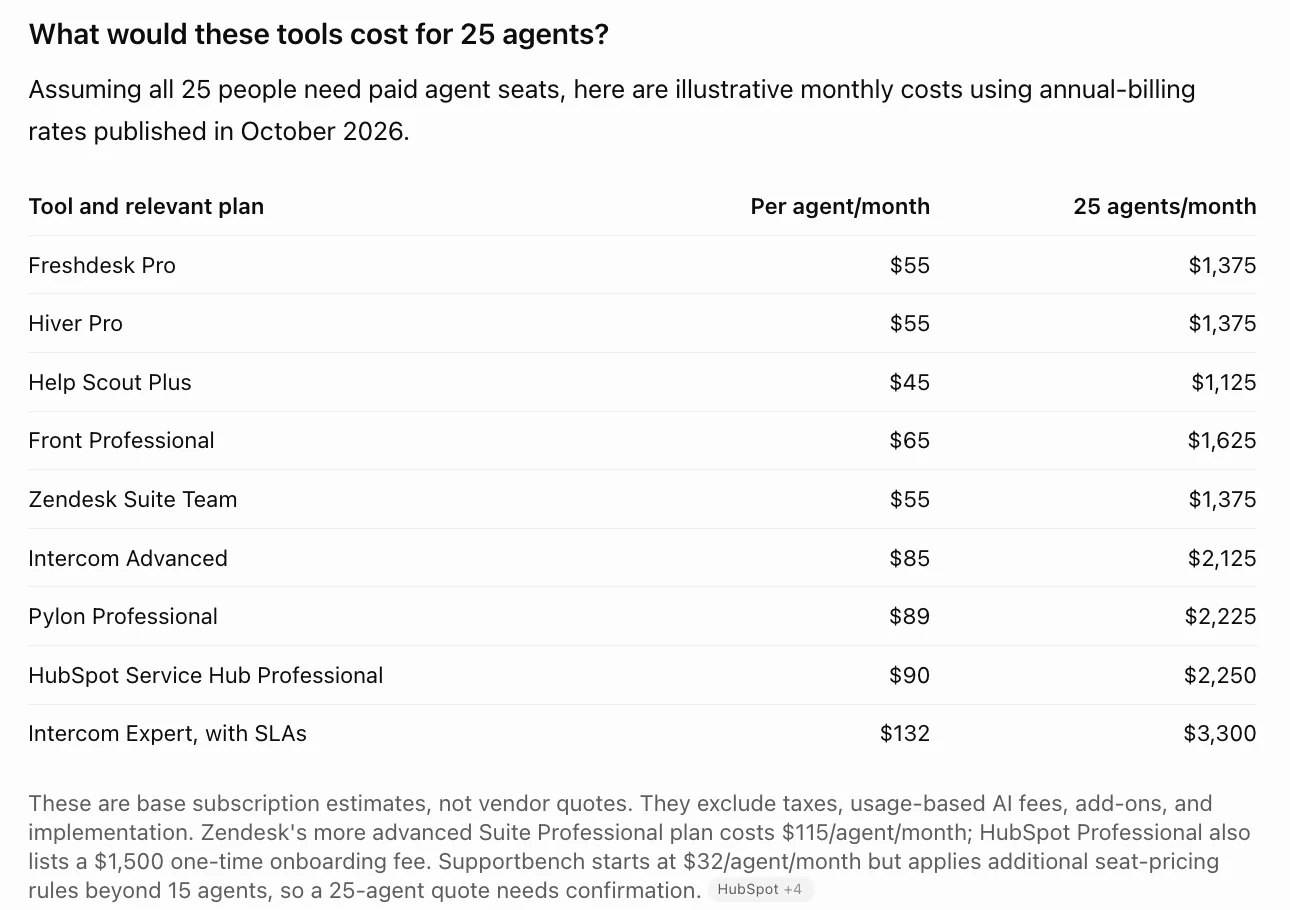
This also lines up with a separate test by Omnius, which looked at 20 customer service software vendors.
When ChatGPT provided a price for a vendor that publicly listed its pricing, it cited that vendor’s pricing page in 289 out of 369 answers.
For vendors without publicly available pricing, it cited their pricing pages in just 10 out of 54 answers.
There was another pattern in my data that caught my attention.
Whenever ChatGPT actually opened a page to read it, that page had a pretty good chance of being cited.
Across the test, ChatGPT opened 156 pages and cited 132 of them. That’s 85%.
My best guess is that the year might help ChatGPT find pages that look current, but when it comes to choosing citations, it’s more interested in the specific information it needs to answer the question.
And for buyer questions, that often means pricing.
Of course, that’s only my interpretation. The network data tells me which pages ChatGPT found, opened, and cited. It doesn’t tell me why it made those choices.
So I wouldn’t treat that explanation as a proven finding.
What this test can’t tell us
Before anyone starts removing years from their page titles, there are a few limitations worth keeping in mind.
1. The sample is small.
I ran 45 questions, once each, on a single day, using one ChatGPT account. That’s nowhere near enough to establish a general rule, especially since ChatGPT can return different searches and citations for the same question on different runs.
2. I only tested three B2B software categories.
My questions covered customer support software, healthcare credentialing, and digital signage. I have no idea whether I’d see the same pattern with ecommerce, local businesses, news, or other kinds of searches.
3. I couldn’t see every search ChatGPT ran.
Although ChatGPT performed 247 search steps, the actual search text was visible for only 47 of them. So the 64% figure applies to the searches I could inspect, not every search ChatGPT performed.
4. I classified page types using titles and URLs.
I used patterns like “best,” “top,” and “/pricing” to group pages. That works well enough for this kind of analysis, but some pages will inevitably have ended up in the wrong category.
5. The data shows correlation, not causation.
Pages with a year in the title had a lower citation rate. That doesn’t mean the year caused the lower rate. Other factors, including the type of page, could explain the difference.
There’s also the question of whether this finding applies beyond ChatGPT.
I didn’t test Google’s AI Overviews, Perplexity, or Claude, so I can’t say anything about how those systems would behave.
And importantly, there’s some larger research that points in the opposite direction.
SISTRIX analysed 48,527 cited pages from ChatGPT and Google’s AI answers, comparing them with uncited pages from the same websites.
They found that pages with 2025 or 2026 in the title were cited 2.7 times as often.
That’s quite different from what I saw.
But even the SISTRIX researchers cautioned against interpreting the finding as a simple title optimisation tactic. They specifically pointed out that “this is not a title trick,” because the year can also indicate that the content has been recently published or maintained.
Their methodology was different from mine, and they described their findings as an initial indication.
For now, I don’t know which pattern would hold up across a much larger sample using a consistent method.
Both are worth keeping an eye on.
What I’d actually do with your page titles
For starters, I wouldn’t go through your website tomorrow and remove the year from every title.
My test didn’t find any citation advantage from including it, but it also doesn’t prove that adding the year hurts your chances.
I’d treat it as neutral at best for now, rather than something you should do specifically to get cited by ChatGPT.
What I would spend more time on is understanding which pages ChatGPT tends to cite for the questions your buyers are asking.
And based on my results, I’d start with your pricing page.
Pricing pages had the highest citation rate of any page type I looked at. ChatGPT also went looking for pricing information in plenty of cases where I hadn’t asked for it.
So if you have publicly available pricing, make it easy to find and understand.
Spell out your plans, prices, and limitations in text on the page, and keep everything up to date.
Think about the questions a potential buyer might ask. If someone wanted to know what your software would cost for 25 users, could they work that out from your pricing page?
For listicles, I’d keep publishing them when they genuinely help the people reading them.
Just don’t assume adding “2026” to the title will make ChatGPT more likely to cite the page.
I’d also recommend looking at the searches ChatGPT runs for questions in your own category.
Even if those searches don’t tell you exactly why it chose a source, they can reveal the kinds of information it’s looking for while answering your buyers’ questions.
FAQs
Should I remove the year from my page titles?
I wouldn’t, at least not based on this test.
Pages with the year in their title weren’t cited more often in my data, but 45 questions aren’t enough to conclude that including it hurts either.
If you update a page regularly, say a software pricing comparison you refresh every January, including the year can be useful for readers who want to know they’re looking at current information.
But if all you’re changing is “2025” to “2026” in the title, I wouldn’t expect that alone to do much for your ChatGPT citations.
Why does ChatGPT add the year to its searches?
I can’t say for certain why it does it, but I can tell you how often I saw it happen.
Of the 33 questions where I didn’t mention a year, 31 led to at least one search where ChatGPT added one itself. And almost every time, that year was 2026.
My guess is that ChatGPT is looking for current information, particularly things like pricing, which can change from year to year.
But that’s an interpretation. The network data doesn’t tell us why ChatGPT decided to include a year.
Can you see what ChatGPT searches for?
Yes, to an extent.
ChatGPT’s web app streams data to your browser while generating an answer. Some of that data includes the search queries it runs, under a field called search_model_queries.
That’s what I used for this analysis.
But don’t expect to see every query. In my test, the search text was only available for 47 of the 247 search steps.
It’s also internal data, so OpenAI could change how it’s exposed at any time.
Does this apply to Google AI Overviews or Perplexity?
I can’t say because I didn’t test either of them.
Different AI search systems can retrieve and select sources differently, and my findings only cover ChatGPT.
The SISTRIX study I mentioned earlier included both ChatGPT and Google’s AI answers, but it used a different methodology.
If you want to understand how your content performs across these platforms, I’d recommend testing each one separately rather than assuming they’ll behave the same way.
What I’m taking away from this
The main thing I wanted to find out was whether adding the current year to a page title actually improves its chances of being cited by ChatGPT.
And in my small test, I couldn’t find evidence that it did.
ChatGPT frequently added 2026 to its searches, even when I hadn’t mentioned a year in my question. But the pages it ended up citing were mostly from vendors’ own websites, with pricing pages performing particularly well.
That doesn’t settle the debate, of course. It’s just 45 buyer questions across three software categories, and I’d be interested to see what happens when someone runs a much larger test.
For now, though, I wouldn’t make adding the year to your titles a priority purely for ChatGPT citations.
If you run an SEO agency, the practical step is to check each client’s pricing page on a schedule. In OthFlow, that check can be a deliverable in each client’s cycle, moving from Brief through QA and Client Review like the rest of the work. See how OthFlow runs SEO retainers.

Written by
Founder of OthFlow
Tim is the founder of OthFlow. He’s worked in SEO for seven years and has helped more than 50 businesses grow their pipeline and hit their goals through SEO and AI search.
Connect on LinkedIn